

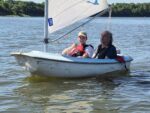
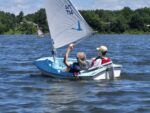
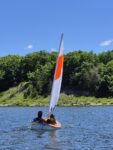
With his father Jens as his inspiration, Brad Biskaborn will compete in the Nautel Laser Worlds and laser master world championships this summer.
It will be the young man against the sea. And that's just the way Brad Biskaborn likes it.
For almost three weeks, the 24-year-old Londoner will take on not only the waters of St. Margaret's Bay, Nova Scotia, but also some of the best laser sailors in the world. Biskaborn is one of 17 Canadian sailors selected to compete in the 2009 Nautel Laser Worlds and laser master world championships- Aug. 17-Sept 5. With 54 countries competing and about 180 sailors taking part, it is being tagged as one of the biggest sailing regattas in Canadian history.
"I'm looking forward to it. My dad is really looking forward to it," Biskaborn said. "He's been sailing all his life. He knows how important this is. We'll be driving down together. I'm really excited for it. It's going to be very challenging." Father Jens is the main reason Biskaborn got into sailing. "My parents wanted to make sure we weren't afraid of the water," Biskaborn said. "I started sailing with Dad, crewing for him almost as a baby. I didn't start in the Laser until I was about 15. For the first couple of years, I stayed at the home yacht club at Fanshawe and then started traveling to Sarnia, Kingston, and Toronto."
Biskaborn, a Fanshawe College student, qualified for the Laser Worlds based on results of past regattas. Last year at the Canadian Olympic regatta he was 15th out of 94 going into the last day but a miscommunication led him to believe the last day of sailing had been cancelled. He didn't show up for the race and dropped seven places to 22.
"I've won regattas but this is a big one for me," he said of the event that hasn't been held in Canada in almost 30 years. "The next biggest event is the Olympics. The major worlds are for the guys that go to the Olympics. Of the 54 countries, 43 competed in the Olympics. The top 43 guys from each country will have gone to the Olympics. "A lot of countries criteria are, you have to do well in main events to do well for your country or to become a carded athlete." Biskaborn says there will be younger people than him in the regatta but that it takes years to become one of the top people in the boat.
The Laser is a one-person boat that's 4.2 metres (14 feet) in length. It's one of the most popular boats in the world, with its ability to fly over the water a main attribute. The cost of a new boat is about $6,500, the biggest expense after purchase being the $600 sails.
"I'm going to be competing against professional sailors. It's their life," Biskaborn said. "These guys are training five, six days a week and they are funded."
Biskaborn is not a carded athlete and gets help with the sport from family, especially his brother (Kevin). That allows him to spend as much time as he can in the boat. "You get better by spending time in the boat," he said. "You have to do it; you can read books and watch movies.” Depending on the wind, I practice two to four hours every time I'm out there. I love doing it. I'm in it as much as I can, maybe three, four days a week. Whenever I can juggle my schedule, when the girlfriend lets me, when the family lets me."
Biskaborn loves the speed, the freedom and the independence the sport offers. Unlike motorized sports, where winning and losing often comes down to who has the better equipment, Laser sailing is all about skill. "It's competitive. It's intense. When it's windy, these boats move. You don't get a thrill like that in a motorboat," Biskaborn said. "You can't blame the boat. The thing about the Laser is its all one design. It's not the boat that's better, the sails that are better. It's all based on the person. "If you're beating people it's not because I made something better yesterday, it's because you've sailed better."
No athlete can ask for anything more.